


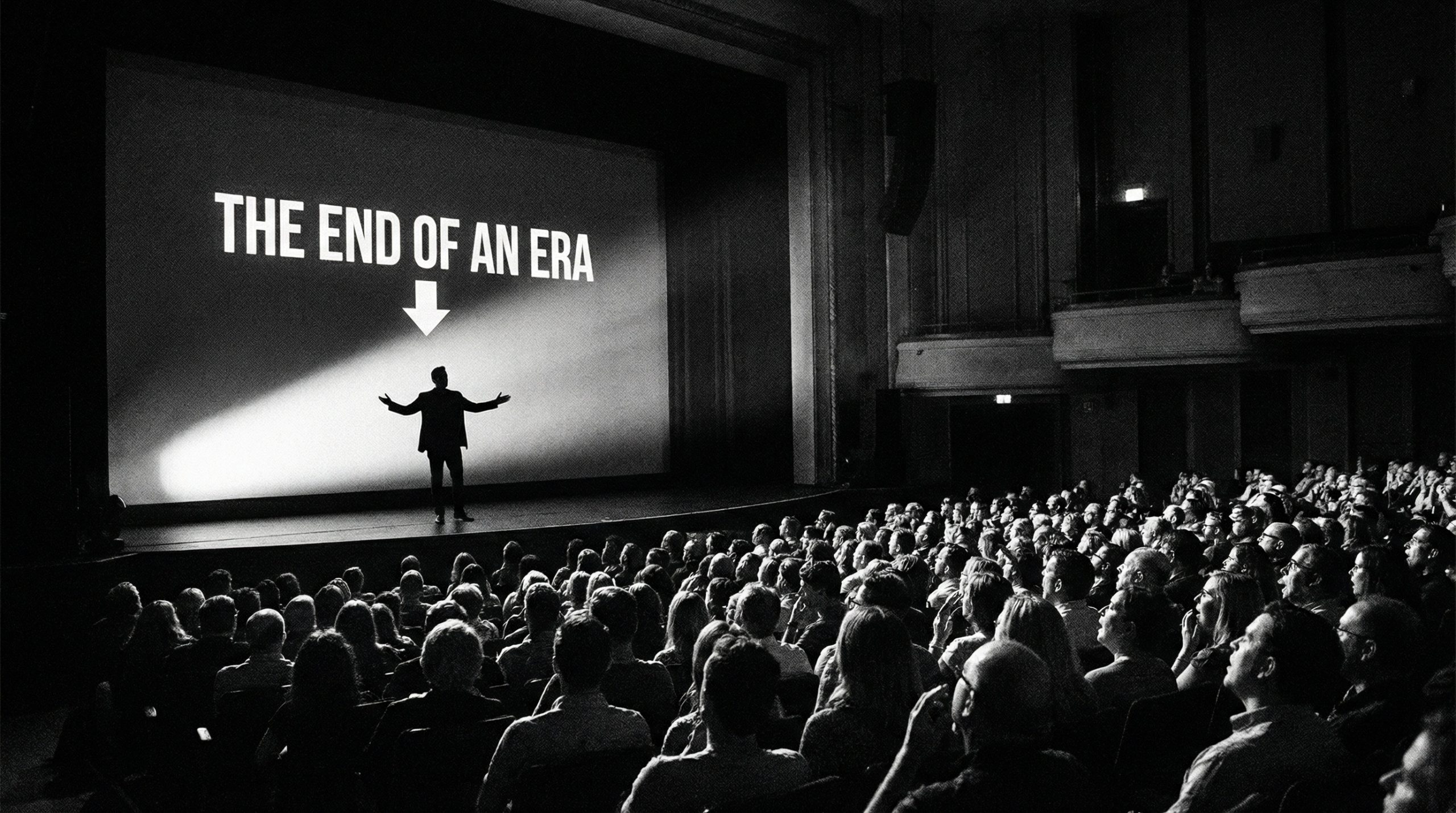
A Single Image That Stopped a War Room in Its Tracks
In 2006, Al Gore stood in front of a darkened theater and showed a graph. A single curve climbing steeply upward — global temperature over 650,000 years. The audience didn’t gasp because of the data. They gasped because of the cherry picker. Gore literally rode a mechanical lift alongside the projected graph to reach the peak, turning a PowerPoint moment into a visceral, unforgettable experience.
That’s what the best presenters do. They don’t just display information — they make you feel it. Here are 7 famous presentation moments where a single slide, a single visual, or a single scene changed how people think, act, or see the world.
1. Al Gore and the Carbon Curve — “An Inconvenient Truth” (2006)
Gore’s climate change presentation wasn’t just a talk — it became an Oscar-winning documentary. But at its core, it was a man with a slideshow. The genius was in his visual storytelling. That temperature graph wasn’t new science. Climate researchers had shown similar data for decades. But Gore made it theatrical.
He walked alongside the graph projected behind him, narrating each rise and fall across millennia. And when the curve shot beyond anything in human history, he stepped onto a cherry picker to follow it up. The audience watched in stunned silence. That one visual did more for public understanding of climate change than a thousand scientific papers.
The lesson? Scale creates emotion. When you make data physically large and personally present, it transcends the screen.
2. Steve Jobs and the Manila Envelope — MacBook Air Launch (2008)
Steve Jobs had already finished describing the MacBook Air — the thinnest laptop ever made. The specs were on screen. The audience was impressed. And then he walked to the side of the stage, picked up a standard office manila envelope, and pulled the laptop out of it.
No slide could have communicated “thin” better than that moment. It was a prop, not a presentation slide, but it functioned as one — a single visual that told the entire story. This is why great slide design sometimes means no slide at all. The most powerful visual is the one that makes the audience’s jaw drop.
3. Hans Rosling and the Washing Machine — TEDTalk (2010)
Swedish statistician Hans Rosling didn’t just use animated bubble charts (though those were revolutionary). In his 2010 TED talk, he brought a washing machine on stage and delivered a passionate speech about why it was the greatest invention of the Industrial Revolution.
His argument? The washing machine freed women from hours of manual labor, allowing them to read, educate themselves, and enter the workforce. He connected a household appliance to global gender equality — and he did it with theatrical energy that would put most keynote speakers to shame.
One object. One argument. Total transformation of how the audience thought about progress and poverty. Rosling proved that turning numbers into stories isn’t just about charts — it’s about finding the human truth behind the data.
4. Elon Musk and the Cybertruck Window — Tesla Event (2019)
Not every famous presentation moment goes according to plan. When Elon Musk unveiled the Cybertruck, he wanted to demonstrate its “armor glass” by having someone throw a metal ball at the window. The window shattered. Twice.
Musk’s response? “Well, maybe that was a little too hard.” He continued the presentation with two cracked windows behind him — and the internet exploded. The moment generated more media coverage than any polished demo ever could have. It became the most-discussed product launch of the year.
The accidental lesson: imperfection can be more memorable than perfection. Audiences connect with real, unscripted moments. If something goes wrong in your presentation, own it. Authenticity beats polish every time.
5. Malala Yousafzai at the United Nations — One Girl’s Story (2013)
On her 16th birthday, Malala Yousafzai stood at the United Nations podium and delivered a speech that moved the world. She didn’t use slides at all. She used words. And one central image that she painted with language: a girl who was shot for wanting to go to school, standing before world leaders to demand that every child be given that right.
Malala’s “slide” was herself — her presence, her survival, her courage. She demonstrated that sometimes the most powerful visual in a presentation is the presenter. Your personal story, told with clarity and conviction, can be more persuasive than any designed deck.
This connects deeply to why powerful presentations aren’t about technology — they’re about human connection.
6. Jeff Bezos and the “Two Pizza” Slide — Amazon Culture
Jeff Bezos is famously anti-PowerPoint. At Amazon, slideshow presentations are banned in favor of six-page narrative memos. But one concept Bezos introduced became its own kind of cultural slide: the “two-pizza team” rule. If a team can’t be fed by two pizzas, it’s too big.
This single concept — communicated not through slides but through a vivid, tangible metaphor — changed how thousands of companies structure their teams. It shows that a powerful concept expressed simply can spread further than any presentation deck. Sometimes your most impactful “slide” is a metaphor that people carry with them and repeat to others.
7. Charity: Water and the Jerry Can — Scott Harrison’s Fundraising Pitch
Scott Harrison, founder of Charity: Water, doesn’t just talk about the water crisis. He brings it into the room. In his famous fundraising presentations, he carries a yellow jerry can filled with dirty water — the same type of container that millions of people carry for miles every day to collect their only water source.
He places it on stage and invites audience members to lift it. Forty pounds. That’s what a child carries. Every day. For hours. The room goes silent every time.
Harrison’s presentation has raised hundreds of millions of dollars. And the most powerful moment isn’t a slide — it’s a physical object that makes an abstract crisis tangible. This is presentation design at its most transformative — when you stop decorating slides and start creating experiences.
The Common Thread: Making the Invisible Visible
Every presenter on this list did the same thing differently. They took something abstract — climate data, product dimensions, poverty, injustice, corporate culture — and made it physically real for their audience. They understood that presentations aren’t about transferring information. They’re about transferring feeling.
Here’s what they all share:
- They used contrast. Before vs. after. Old vs. new. Problem vs. solution.
- They engaged multiple senses. Not just sight, but touch, movement, and spatial awareness.
- They simplified ruthlessly. One message. One image. One moment.
- They told human stories. Not statistics about millions — stories about one person.
What You Can Steal for Your Next Presentation
You don’t need a cherry picker or a United Nations podium. But you can apply these principles right now:
- Find your “one slide.” What is the single most important visual in your presentation? Build everything around it.
- Bring something physical. A prop, a sample, a printed photo. Objects create attention in ways screens cannot.
- Make data human. Don’t say “3 billion people.” Say “half the people on this planet.” Better yet, tell the story of one of them.
- Embrace the unexpected. Plan for a surprise moment — or be ready to roll with one that happens naturally.
The presenters who changed the world didn’t do it with fancier software or more animations. They did it by finding the one image, the one object, the one story that made their audience see the world differently. Your audience doesn’t remember your data. They remember how you made them feel. And that feeling starts with one powerful moment.
What will yours be?