


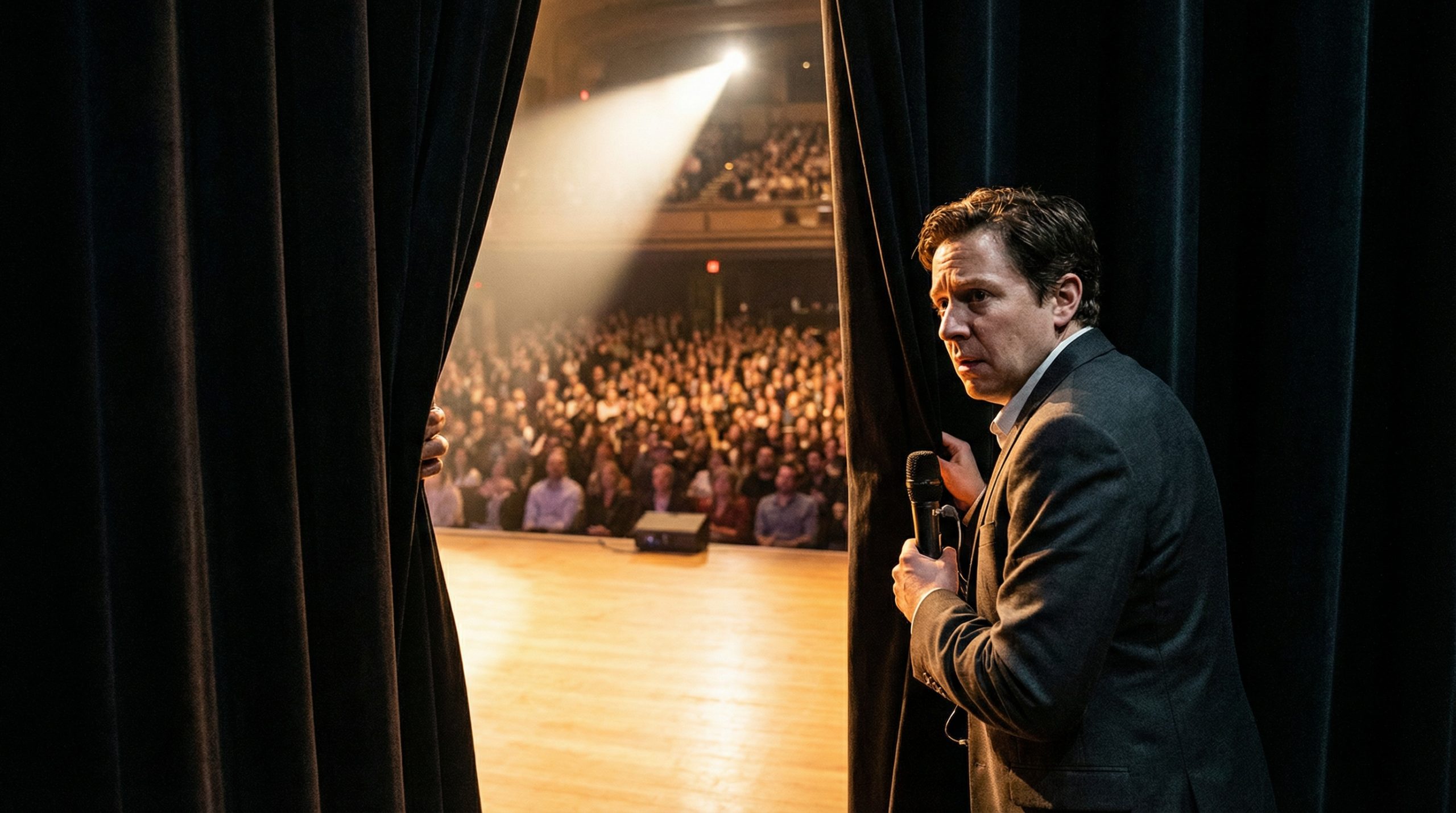
I remember the first time I stood on a stage and felt my body betray me. It was a regional debate competition — I was nineteen, I’d prepared for weeks, and I was confident right up until the moment I walked to the podium. Then my hands started shaking. My mouth went dry. My heart was pounding so loudly I was convinced the microphone was picking it up. I opened my mouth to deliver my carefully memorized opening line, and what came out was… nothing. Just silence and the sound of 300 people waiting.
That was twenty years ago. Since then, I’ve coached hundreds of speakers, delivered TEDx talks, spoken at conferences on four continents, and presented to rooms ranging from twelve executives to five thousand conference attendees. And I still get nervous. Every single time.
Here’s what changed: I stopped trying to eliminate the fear and learned to channel it. It’s not about eliminating nerves — it’s about channeling them. These eight techniques are what I teach every speaker I coach, and they’re the same ones I use myself before every talk.
1. Reframe the Fear as Fuel
Your body’s stress response before a presentation — the racing heart, the sweaty palms, the tight chest — is physiologically almost identical to excitement. Research from Harvard Business School showed that people who said “I am excited” before a stressful performance actually performed better than those who tried to calm down.
This isn’t pop psychology — it’s a genuine cognitive reframe. When you feel the adrenaline hit before a talk, don’t tell yourself “calm down.” Tell yourself “I’m ready. This energy is going to make me sharper, faster, more present.” The physical sensation doesn’t change, but your relationship to it does. And that changes everything.
I do this every single time. Standing backstage, heart hammering, I literally whisper: “This is fuel.” It sounds ridiculous. It works.
2. Arrive Early and Own the Space
One of the biggest amplifiers of stage fright is unfamiliarity. You walk into an unknown room, with unknown technology, in front of unknown faces, and your brain codes the entire situation as threatening. The fix is simple: remove as many unknowns as possible before you present.
I arrive at every venue at least an hour before my talk. I walk the stage. I test the microphone. I stand at the podium and look out at the empty seats. I click through my slides on the actual projector. I find the light switches. I locate the water.
By the time the audience arrives, I’ve already been in that space for an hour. It’s not an unknown room anymore — it’s my room. The stage isn’t a threat; it’s territory I’ve already claimed. This technique alone has reduced my pre-talk anxiety by half.
3. Master Your Opening Cold
Stage fright is most intense in the first 60 seconds. After that, most speakers find their rhythm and the fear recedes to a manageable hum. So the strategic move is obvious: make your opening bulletproof.
I rehearse my first three sentences until I could deliver them in my sleep — in the shower, walking the dog, waiting for coffee. Not just the words, but the pacing, the pauses, the eye contact pattern. When I step on stage, those opening sentences come out on autopilot, giving my conscious brain time to settle while my mouth does the work.
Here’s the key: don’t memorize your entire talk word-for-word (that creates a different kind of anxiety — the fear of forgetting a specific phrase). But do memorize your opening. The rest can be more fluid. Practice doesn’t make perfect. Practice makes prepared. And for your first 60 seconds, prepared is everything. For more opening techniques, our complete guide to powerful presentations has specific strategies.
4. Use the 4-7-8 Breathing Technique
This isn’t generic “take a deep breath” advice. The 4-7-8 technique is a specific breathing pattern that activates your parasympathetic nervous system — the opposite of fight-or-flight:
- Breathe in through your nose for 4 seconds
- Hold your breath for 7 seconds
- Exhale slowly through your mouth for 8 seconds
- Repeat 3-4 times
I do this backstage, usually while standing in a bathroom stall (glamorous, I know). Three rounds of 4-7-8 breathing takes about 90 seconds and noticeably drops my heart rate. The science is real: extended exhales stimulate the vagus nerve, which signals your body to stand down from high alert.
Don’t try this for the first time right before a big talk. Practice it during low-stress moments first — before bed, during commutes — so your body learns the pattern. Then when you deploy it backstage, the calming response kicks in faster because you’ve trained it.
5. Strike a Power Pose (Yes, It Actually Helps)
I know the “power pose” research by Amy Cuddy has been debated in academic circles. But here’s what I know from coaching hundreds of speakers: the physical posture you hold before a presentation measurably affects how you feel during it. Whether that’s because of hormonal changes or simply because standing tall with open body language makes you feel more confident — the mechanism matters less than the result.
My pre-talk ritual: two minutes standing backstage with feet shoulder-width apart, hands on hips, chest open, chin slightly raised. I look ridiculous. I feel powerful. And that feeling carries into my first few minutes on stage, which is exactly when I need it most.
The opposite is equally true. If you spend the ten minutes before your talk hunched over your phone, scrolling nervously through your slides, you’ll walk on stage carrying that contracted, anxious energy. Physical state drives emotional state. Use it deliberately.
6. Find Three Friendly Faces
A sea of faces is intimidating. Three friendly faces are not. This is one of the most practical stage fright techniques I know, and I use it every single time.
When the audience is settling in (or during the first few seconds of your talk), identify three people in different parts of the room who are making eye contact, nodding, or smiling. These are your anchors. During your talk, when anxiety spikes, look at one of them. Their positive body language gives you real-time feedback that says “you’re doing fine.”
I’ve spoken to audiences where 90% of the room had neutral expressions (which is normal — most people’s listening face looks disinterested even when they’re engaged). Without my anchor faces, I would have spiraled into “they hate this.” With them, I had three people whose nods kept me grounded.
7. Build In Interaction to Break the Monologue Pressure
One of the hidden sources of stage fright is the pressure of continuous performance. Thirty minutes of uninterrupted speaking is exhausting and anxiety-inducing. But break that into segments with audience interaction, and the pressure drops dramatically.
Plan interaction points every 8-10 minutes:
- “How many of you have experienced this?” (show of hands)
- “Turn to the person next to you and share one example” (pair discussion)
- “I’m curious — what do you think happened next?” (rhetorical but creates engagement)
These moments do three things: they give you a breather, they reset audience attention, and they transform a monologue into a conversation. And conversations are far less terrifying than performances.
Watch any great TED speaker and you’ll notice they create interaction even in formats that don’t technically allow it — through questions they pause after, through moments of humor where the audience’s laughter creates a natural break. Our closer look on what makes TED speakers so compelling analyzes exactly how they do this.
8. Create a Pre-Talk Ritual
Every top performer — athletes, musicians, actors, speakers — has a pre-performance ritual. Not because of superstition, but because rituals create psychological predictability in an unpredictable situation.
Here’s mine, and I’ve used it before every significant talk for the past decade:
- Arrive early. Walk the stage. Test tech. (30-60 minutes before)
- Find a quiet corner. Do 4-7-8 breathing, four rounds. (10 minutes before)
- Power pose for 2 minutes.
- Whisper my opening three sentences out loud, twice.
- Say “This is fuel” one time.
- Walk on stage.
The ritual itself doesn’t matter — what matters is that it’s consistent. Over time, your brain associates the ritual with “presentation mode,” and the sequence becomes a reliable on-ramp from anxiety to readiness.
Build your own version. Maybe yours includes listening to a specific song, or doing jumping jacks, or calling a friend. Whatever puts you in the right headspace — codify it, practice it, and use it every time.
The Truth About Stage Fright
Here’s something I tell every speaker I coach, usually when they’re feeling discouraged about their nerves: the goal is never to feel no fear. The goal is to feel fear and speak anyway.
I’ve spoken to audiences of thousands. I’ve coached TEDx speakers, Fortune 500 executives, and first-time presenters giving their wedding toast. Every single one of them was nervous. The ones who succeeded didn’t succeed because they weren’t afraid — they succeeded because they had tools to manage the fear and enough preparation to perform through it.
Your next presentation is your next chance. Not to be fearless — that’s not realistic and honestly, not even desirable (fear keeps you sharp). But to be courageous. To stand up, feel the adrenaline, and channel it into something your audience will remember.
If you’re working on becoming a stronger presenter overall, pair these techniques with the strategies in our complete guide to powerful presentations. And if you’re preparing for a virtual presentation where the dynamics are different, our remote presentations guide covers the unique challenges of presenting on Zoom — including a whole different kind of stage fright.
The stage is waiting. And you’re more ready than you think.