


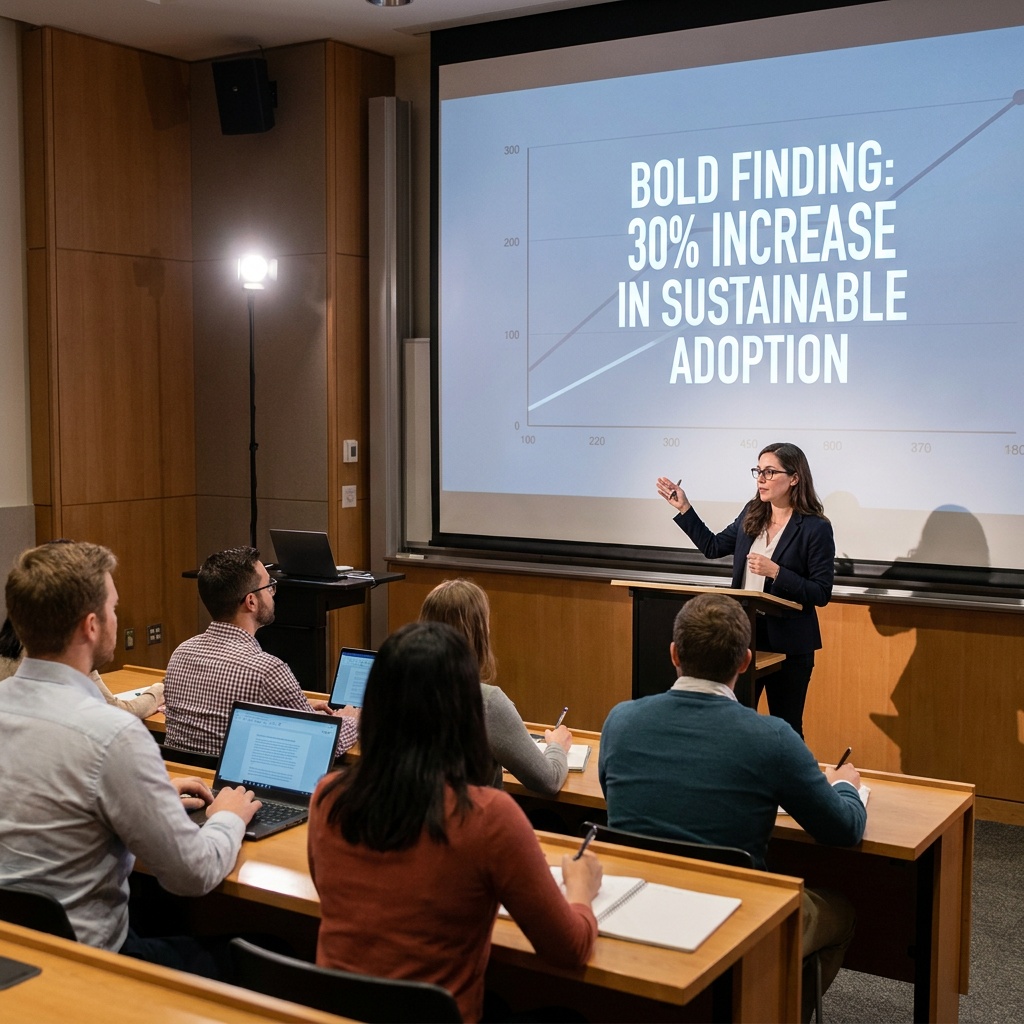
I’ve sat through more academic research presentations than I’d care to count. Most of them have one thing in common: the presenter has 30 slides and the audience needs 6.
This isn’t a knock on researchers. The instinct to show your work, in detail, with appropriate caveats, is exactly right for a journal article or a thesis defense committee. But it’s exactly wrong for a 15 or 20-minute presentation, which is the format most research findings get presented in. Conference talks, departmental seminars, job talks, public lectures, even funding pitches. All of them suffer from the 30-slides-for-6-slides problem.
This piece is about how to cut the 30 down to the 6. What to keep. What to leave out. How to design each of the six so a non-expert can still follow your work without you having to dilute its rigor.
Why Six?
Six slides isn’t arbitrary. It maps to the six pieces of information an audience actually needs to absorb your research:
- What question were you trying to answer?
- How did you try to answer it (in one sentence)?
- What did you find?
- What’s the evidence for that finding?
- Why does it matter?
- What’s still unresolved?
That’s the entire information architecture of any research presentation. Everything else, the literature review, the detailed methodology, the secondary findings, the discussion of limitations, the citation list, belongs in your paper, not on your slides. Your audience can read your paper at their leisure. Right now they need the headline version.
You can use more than six slides. Section dividers, examples, a single quote, sometimes a second-finding slide. But the six structural slides below are non-negotiable. Skip any of them and the audience leaves confused about something important.
Slide 1: The Question
The first content slide (after your title slide) should be your research question, written as a single sentence in large type. No background. No literature review yet. Just the question.
The trick is to write the question in plain English, not academic English. Compare:
- Academic version: “This study investigates the relationship between socioeconomic status and adolescent screen time as moderated by parental engagement variables.”
- Plain English version: “Do wealthier teens spend less time on their phones, and does parenting style change that?”
The academic version sounds rigorous. The plain English version is actually understood by a wider audience, including the people who fund your research. Use the plain English one on your slide. Save the formal language for your paper.
Slide 2: The Method (One Sentence Maximum)
Methodology is where research presentations go to die. The temptation is to walk through every sampling decision, every variable, every analytical choice. That’s appropriate for your dissertation committee. It’s lethal in a 15-minute conference talk.
For the talk version, one sentence is enough. Examples:
- “We tracked screen time on 2,400 teenagers across 12 months using a custom app that ran in the background of their phones.”
- “We interviewed 45 emergency room nurses across three hospitals and analyzed the transcripts using grounded theory coding.”
- “We ran 18 mice through a memory task before and after a specific gene was deactivated, then compared performance.”
That’s it. Sample, instrument, comparison. If methodology is the entire point of your work (you’re presenting a novel method, for example), this becomes the centerpiece instead. But for findings-focused talks, one sentence is the right level of detail. Anyone who wants more will ask in Q&A or read your paper.
Slide 3: The Finding (In a Single Sentence)
This is the most important slide in your entire deck. The single finding you most want your audience to remember, written as one sentence, in the biggest type on any slide in your presentation.
The structure of a good finding sentence: subject, action, specific outcome. Examples:
- “Wealthier teens actually spend MORE time on their phones, not less, and parental engagement doesn’t change it.”
- “ER nurses identify failing patients 8 minutes earlier than electronic monitoring systems do.”
- “Mice with the FOXP2 gene deactivated took 4x longer to remember the maze.”
The mistake most researchers make on this slide is hedging. “Our results suggest there may be a relationship between…” is forgettable. “X did Y by 40%” is memorable. Save the hedging for your paper, where peer reviewers expect it. On the slide, state the headline finding cleanly.
If you have multiple findings, pick the most important one for this slide and put the secondary findings in your supporting slides or in your speaker notes. Don’t dilute the headline.
Slide 4: The Evidence (One Visualization)
Now you back up the finding with the single most convincing piece of visual evidence. One chart. One image. One table. Not all three. Pick the one that most directly proves the headline.
The principles of a good evidence visualization, in order of importance:
- The audience can read it from the back row. If your chart’s axis labels need a magnifying glass, redesign it bigger.
- The pattern is visible in 3 seconds. Before any axis label is read, the shape of the data should already tell the story. If you need to explain what to look at, the chart is wrong for the slide.
- Color highlights the key finding. Use a neutral gray for context data and a single bright accent color for the data point that proves your finding. The eye goes to the color.
- The title is the finding, not the variable. “Screen time by income quintile” is a description. “Wealthier teens spend 23% more time on screens” is a finding. Use the finding as the chart title.
If your data is too complex to fit on one chart, that’s a signal to either simplify the analysis you’re presenting (saving the rest for the paper) or split the finding across two slides. Don’t cram. We’ve got more on this in our piece on presenting data without boring your audience.
Slide 5: Why It Matters (The Implication)
This is the slide most researchers skip, and it’s the slide that determines whether your audience remembers your work next week.
Your finding has implications. Maybe it changes a clinical practice. Maybe it overturns a previous assumption in your field. Maybe it points to a policy intervention. Maybe it opens a new line of research that wasn’t possible before. Whatever the implication is, state it plainly on this slide.
The format that works: a single sentence connecting the finding to a real-world consequence.
- “This means our current screen-time interventions, which target low-income families, are aimed at the wrong group.”
- “This means hospitals could detect deteriorating patients earlier by giving nurses formal early-warning authority.”
- “This means FOXP2 may be a viable target for memory-related drug development.”
If you can’t articulate why your finding matters to anyone outside your subfield, the audience has no reason to remember it. The “so what” is not a nice-to-have. It’s the reason your work earned the right to take 15 minutes of everyone’s time.
Slide 6: What’s Still Unresolved
End your talk on the limits of what your work actually showed. This sounds like weakness. It’s actually the strongest move you can make, for two reasons.
First, it shows intellectual honesty. Audiences (especially academic audiences) trust presenters who acknowledge what their work doesn’t prove. Skipping this makes you look like you’re overselling.
Second, it sets up the conversation. By naming the open questions, you give your audience specific things to ask about in Q&A. The Q&A is where the real intellectual exchange happens at most conferences. Don’t end with “thank you,” end with “here are the three things we still don’t know.”
Format: three short bullets. One sentence each. Examples:
- “We don’t yet know whether this pattern holds outside the US.”
- “Our sample skewed toward urban hospitals. Rural settings may differ.”
- “The mechanism connecting income to screen time is still unclear.”
Then stop. Don’t move to a “thank you” slide with your email address. The limits slide can be the last slide. Your contact information can go in a footer or in your introduction.
What to Cut From Most Research Presentations
If you’re starting from a 30-slide draft, here’s what to remove first, in priority order:
1. The literature review. Your audience either knows the field or they don’t care. If they know the field, the lit review is wasted time. If they don’t care, the lit review will make them stop caring even more. Reduce to one sentence of context if absolutely necessary, no slide.
2. Detailed methodology. Beyond the one-sentence method slide, every additional methodology detail loses audience attention. The methodology section is where conference talks go to die.
3. Secondary findings. Pick one. Save the rest for your paper. A talk with one clear finding lands harder than a talk with five vague ones.
4. Data tables. Tables with more than a few rows are unreadable on slides. Convert to charts or cut entirely. If a number is important, put it on the slide in big type by itself.
5. Citation slides. Nobody reads them. Put your references in the QR-coded handout or the paper itself.
6. The “future research” slide. Different from the “unresolved” slide. “Future research” is generic; “unresolved” is specific. Cut the former, keep the latter.
7. The acknowledgments slide. Thank your funders and collaborators verbally at the start of the talk, not on a slide at the end. Slide-based acknowledgments feel performative and waste audience attention.
Adapting the Six Slides to Different Audiences
The six-slide structure works across audiences, but the language changes for each:
Specialist audience (your subfield): Use field-specific terminology. Skip the broader implication slide if the implication is obvious to insiders. Spend more time on Slide 4 (evidence) because they’ll want to scrutinize the methodology.
Generalist academic audience (your discipline, but not your subfield): Translate terminology. Spend more time on Slide 1 (question) and Slide 5 (implication) so they can locate your work in the bigger picture. Slide 2 (method) can be one sentence even more confidently here.
Decision-maker audience (funders, policymakers, journalists): The implication slide becomes the focal point. They care less about the method than about what they should do differently because of your finding. Reorder the deck if you have to: lead with implication, then provide the evidence as backup.
One six-slide structure, three different emphases. Adjust based on who’s actually in the room.
The Q&A Strategy That Actually Works
Most research talks end with Q&A. Most Q&A sessions are mishandled by the presenter, who treats them like an interrogation rather than a discussion.
Three rules that improve every Q&A:
Don’t restate the question. Researchers are taught to do this for clarity. In practice it wastes time and makes you look like you’re stalling. Just answer.
Say “I don’t know” when you don’t know. The single most damaging Q&A behavior is bluffing. Saying “that’s a great question, I don’t know yet, my best guess is X” is honest and respected. Pretending you know something you don’t is detected by everyone in the room and instantly costs you credibility.
Treat hostile questions as opportunities. The questioner who challenges your method is doing you a favor by showing the audience your reasoning under pressure. Stay calm. Engage the specific objection. Don’t get defensive. If the criticism is valid, acknowledge it. If it’s not, explain why.
For more on managing the Q&A specifically, our guide to handling tough questions goes deeper into specific tactics.
Practice the Talk, Not the Slides
One last thing. The single highest-leverage thing you can do before any research presentation is to give the talk out loud, end to end, with no audience, at least three times. Time yourself.
Most researchers practice by reading through their slides silently. That’s not practicing the talk. That’s reviewing the slides. The talk is what comes out of your mouth, in real time, in a room. The only way to practice that is to actually do it.
If you have time for one piece of preparation, skip the slide polish and run the talk out loud three more times. You’ll find the awkward transitions, the parts where you can’t remember the next point, the places where the slide order doesn’t match how you actually talk through it. Fix those. Your audience will notice the polish, even if they couldn’t say why.
Six slides. One finding. Practice it three times. That’s most of what makes a memorable research presentation, and it’s the part that almost nobody actually does.