

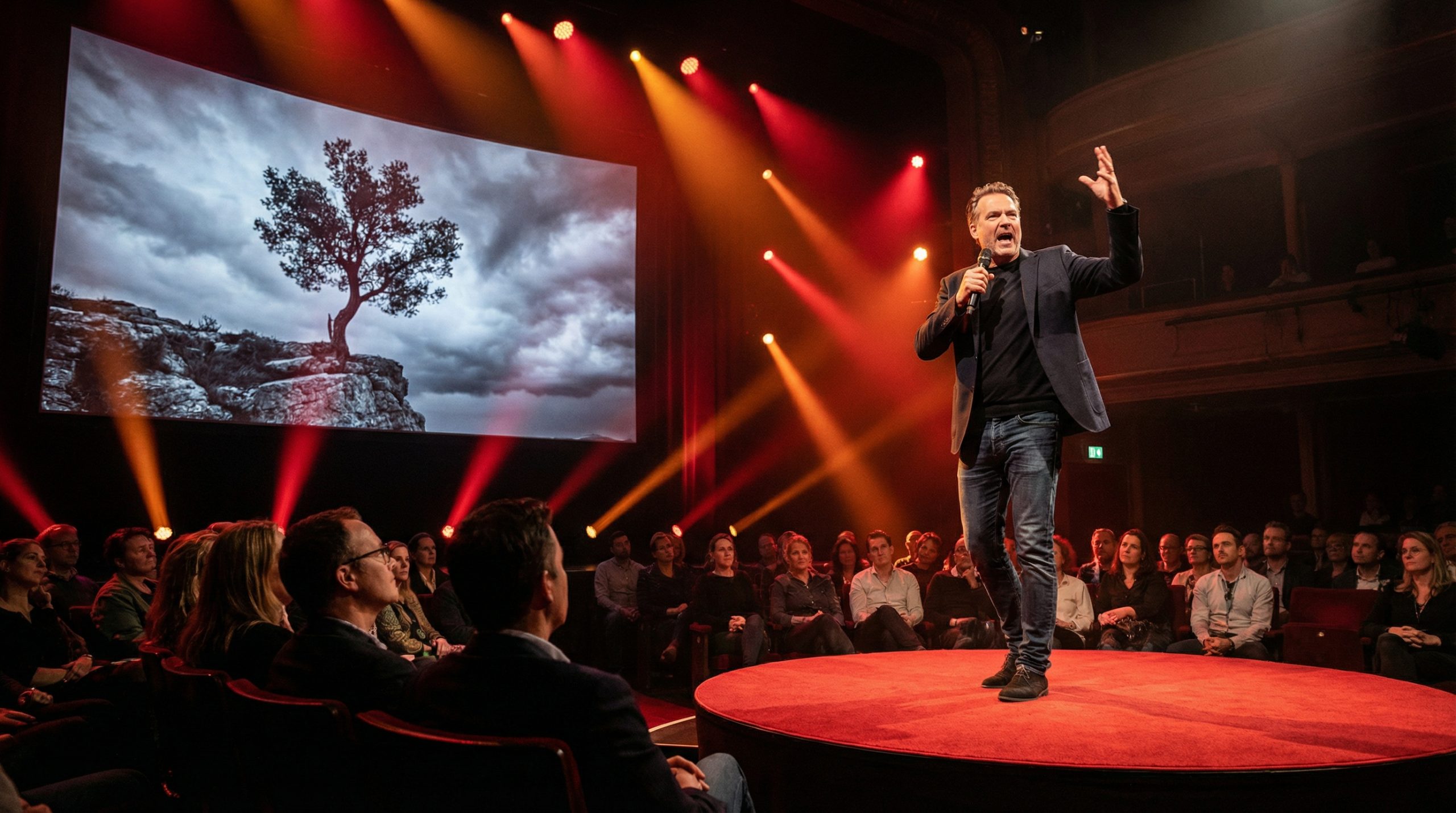
In 2006, Sir Ken Robinson walked onto the TED stage with no slides, no props, and no gimmicks. Eighteen minutes later, he had delivered what would become the most-watched TED Talk of all time — “Do Schools Kill Creativity?” — with over 70 million views and counting. He made the audience laugh 39 times. He told stories about his son, about Shakespeare, and about a girl named Gillian Lynne who couldn’t sit still in school but became one of the greatest choreographers in Broadway history.
No bullet points. No corporate jargon. Just a man with ideas and the skills to make them stick.
What makes TED speakers unforgettable isn’t talent or charisma — it’s technique. And the best part? These TED talk presentation skills can be learned, practiced, and applied to any presentation you’ll ever give.
The 18-Minute Rule: Why Constraint Creates Impact
TED enforces a strict 18-minute time limit. It’s not arbitrary. TED’s organizers have long argued that 18 minutes is long enough to be substantive but short enough to hold attention. Neuroscience backs this up — cognitive research suggests that attention significantly declines after about 10-18 minutes of continuous listening.
But here’s what the time limit really does: it forces ruthless editing. When you only have 18 minutes, every sentence must earn its place. You can’t ramble. You can’t pad. You have to know exactly what you want to say, cut everything that doesn’t serve the core message, and deliver with precision.
How to apply this: Even if your presentation is 45 minutes or an hour, pretend you only have 18. Write your core message in one sentence. Then ask of every slide, every anecdote, every data point: does this serve that sentence? If not, cut it. The discipline of compression makes every presentation better.
Story First, Data Second
Watch any great TED Talk and you’ll notice a pattern: they almost always open with a story — not a statistic, not a definition, not “Today I’m going to talk about…”
Brené Brown’s legendary talk on vulnerability opens with a story about a therapist call. “The Power of Vulnerability” has been viewed over 60 million times, and its hook is deeply personal: she tells the audience she’s a researcher who hates vulnerability, and then describes the emotional breakdown that changed her perspective.
Chimamanda Ngozi Adichie’s “The Danger of a Single Story” opens with her childhood — reading British and American books as a girl in Nigeria and assuming that all stories had to feature white children eating apples in the snow.
Stories work because of the neural coupling effect. When a speaker tells a story, the listener’s brain activity mirrors the speaker’s — a phenomenon documented by Princeton neuroscientist Uri Hasson. Facts inform. Stories transform.
How to apply this: Start with a personal story, a client story, or a vivid scenario that illustrates your point. Save your data for the middle of the talk, where it provides evidence for the emotional hook you’ve already set. The structure is: story → insight → evidence → call to action.
The Power of the Pause
Most nervous speakers rush. They fill every silence with “um,” “so,” “basically.” TED speakers do the opposite — they use silence deliberately.
Watch Simon Sinek’s “How Great Leaders Inspire Action” (the famous Golden Circle talk). Notice how he pauses after key statements. He says something provocative — “People don’t buy what you do; they buy why you do it” — and then he stops. He lets it land. That pause gives the audience time to process, to nod internally, to feel the weight of the idea.
The pause also signals confidence. A speaker who can stand in silence for two or three seconds without fidgeting or filling the gap demonstrates command of the room. It says: I trust that what I just said is worth sitting with.
How to apply this: Identify the three most important sentences in your talk. After each one, pause for a full two seconds. It will feel like an eternity to you and feel perfectly natural to your audience. Practice this — it’s a skill that requires rehearsal because our instinct is to fill silence.
Slide Minimalism: Less Is Always More
When was the last time a TED speaker used a slide with six bullet points? It doesn’t happen. TED presentations consistently feature minimal slides — a single image, a short phrase, or no slides at all.
Al Gore’s climate change presentations use powerful visuals — full-bleed photographs of glaciers, simple graphs with dramatic trend lines. Each slide makes one point and makes it visually.
This approach works because of cognitive load theory. When a slide is dense with text, the audience reads the slide instead of listening to you. Their attention splits, and they absorb neither the slide nor your words effectively. A minimal slide keeps attention on you — the speaker — which is exactly where it should be.
How to apply this: Follow the “one idea per slide” rule. If a slide needs a paragraph of text, you need more slides — or fewer words. Use high-quality images that evoke emotion. Use large fonts (30pt minimum). And remember: your slides are not your script. They’re your backdrop.
Vulnerability as a Superpower
Brené Brown didn’t just talk about vulnerability — she modeled it. She told the TED audience about her emotional breakdown, about her resistance to her own research findings, about her imperfections as a human being. And the audience loved her for it.
This is counterintuitive. We assume that speakers need to project perfection, authority, and control. But TED’s most beloved talks consistently feature moments of honest vulnerability — speakers admitting failure, sharing fear, confessing uncertainty.
Andrew Solomon’s talk on depression. Amy Cuddy admitting she felt like an imposter. Jill Bolte Taylor describing her own stroke as it happened. These moments of raw honesty create what psychologists call “self-disclosure reciprocity” — when a speaker is honest, the audience unconsciously feels closer to them and becomes more receptive to their message.
How to apply this: You don’t need to share your deepest trauma. But find one moment of genuine honesty — a mistake you made, something you didn’t know, a time you were scared. Share it briefly and connect it to your larger point. Audiences don’t remember perfect speakers. They remember real ones.
The Memorable Closer: Leave Them With Something Sticky
TED speakers rarely end with “So, in conclusion…” or “Thank you, that’s all I have.” The best ones end with a moment that lingers.
Ken Robinson ended his famous talk with the story of Gillian Lynne — the “problem child” who became a world-renowned choreographer because one perceptive doctor recognized that she wasn’t sick, she was a dancer. The audience was in tears.
Sinek ended with: “Martin Luther King gave the ‘I have a dream’ speech, not the ‘I have a plan’ speech.” Simple, punchy, and unforgettable.
How to apply this: End with one of three things: (1) a callback to your opening story, creating a satisfying loop; (2) a provocative question that the audience takes home; or (3) a clear call to action — one specific thing they can do with what they’ve learned. Avoid ending with a summary slide. End with emotion.
Rehearsal: The Invisible Ingredient
Here’s the secret most people don’t see: TED speakers rehearse obsessively. Chris Anderson, TED’s head curator, has written that most TED speakers rehearse their talks dozens of times. Some work with speaking coaches for months before their 18 minutes on stage.
The irony is that all that rehearsal makes the delivery look effortless. The stories feel spontaneous. The pauses feel natural. The jokes land perfectly. But behind every “natural” TED performance are hours of deliberate practice.
How to apply this: Rehearse your presentation at least five times out loud — not in your head, not by reading your slides. Stand up, speak at full volume, and time yourself. Record yourself on your phone and watch it back (painfully enlightening). Practice in front of someone and ask for honest feedback. The goal isn’t to memorize a script. It’s to internalize your material so deeply that you can deliver it conversationally, adapting to the room in real time.
Bringing TED Techniques Into Your Next Presentation
You don’t need a TED stage to use these skills. Whether you’re presenting to five colleagues in a conference room or five hundred attendees at a summit, the fundamentals are the same: tell a story, make one clear point, use visuals sparingly, pause for impact, show your humanity, and close with something they’ll remember.
The next time you’re building a presentation, ask yourself: would this work as a TED Talk? If the answer is no, you know where to start improving. Strip away the filler. Find the story. Practice until it feels like a conversation. That’s the formula — and it works every time.
For more insights on mastering public speaking and presentation design, explore our full collection of expert guides.